Evergreens for Midwestern Landscapes and Gardens
Year round interest in your landscape is easily achieved with evergreen trees and shrubs.
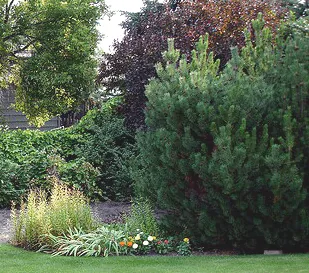
Narrowleaf evergreen (conifers) trees and shrubs are among the most expensive plants used in the landscape, and many of them are not easily moved. So it is important to carefully select and place your evergreens. Since evergreens are often used as foundation or entry plantings, be sure you know the mature size of your selection so your evergreen does not crowd the foundation or block windows. Allow plenty of space between plants and structures for them to grow to full size and still allow passing space for maintenance. See the foundation planting article for guidance. Growth rates follow the size categories below, but can vary dramatically based on the species and conditions.
In the north and midwest, hardiness of evergreens is critical, but there is much more to consider than just cold hardy. Since evergreens do not go dormant in winter, their branches and needles are susceptible to winter burn, sun scald and tip kill. These injuries are caused by drying winds, scalding sun reflecting off snow and low water reserves in the plant and soil. Preventive measures can help, read about protecting your evergreens from winter. Watering evergreens deeply through summer and as far into winter as possible is one of the best ways to minimize winter injury. Evergreens that receive warm afternoon sun in winter warms quickly, then quickly assaulted by freezing temperatures when the sun goes down. The best prevention is to try to select varieties that resist damage from winter.
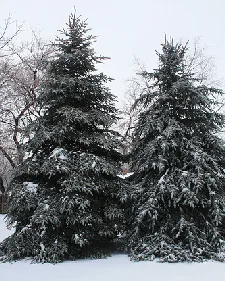
Near roadways, evergreens can be severely damaged by salt spray from snow plows. Since the damage usually cannot be prevented, and often does not heal, the best thing is to plant evergreens a great distance from roadways that are frequently salted, de-iced, and plowed. Plows can send chemical spray as much as 30 to 60 feet into your property.
When used at corners or large bare spaces of your home, in open spaces, or near the perimeter of your property, tall dense evergreens can make a big impact in many ways. Evergreens can add height, color, and texture in all seasons. A grouping of evergreens can create a privacy screen, a noise barrier, or a windbreak to block cold north winds. Evergreens planted on the north side of a drive or patio can create a warm and sunny microclimate in winter by trapping and reflecting sunlight. Smaller shrubs used as foundation plantings can add insulation when properly planted. But poorly placed evergreens can block windows from sunlight making your home dark and dreary, or making a patio cool and gloomy. Deciduous trees that drop their leaves for winter might be a better choice to filter hot summer sun since they will allow sunshine through their bare branches in winter.
Although homeowners and gardeners in the north tend to get bored with the same old arborvitae and yew, they are widely used because of their hardiness and resistance to winter injury. Healthy and boring is a lot better than interesting but half dead. With that said, DO consider selections from the many, many varieties of evergreens. False cypress for example, has proven to be cold hardy and resistant to winter injury in zone 4. The threadleaf branches of lovely golden green are bright and elegant. Many of the junipers are hardy to zone 4 as well as zone 3, and offer a variety of shapes, size, texture and color.
Evergreens offer an array of size and shape for any design need. Globe, tall conical, and pyramid shapes are commonly seen. But many varieties are also available that are spreading with graceful arching branches, spreading with upright branches, low spreading or creeping. And colors range from bright golden yellow or golden green, deep or bright green, and blue green to gray green. Some produce acorns, some produce berries. Some are dense and prickly, some soft and graceful. And there are a lot of topiary evergreens available. Some requiring meticulous pruning to maintain, and some requiring no pruning at all, like the grafted blue spruce or creeping junipers. So don’t let evergreens bore you! Try something new! Information about specific evergreen plants on the following pages are specifically not grouped by genus. Perhaps then you may scroll past something different that catches your eye!
Do your homework before selecting an evergreen. Most evergreens like quite a bit of sun, they all like plenty of water, and good soil with a dose of fertilizer in spring. Some will want a little pruning or shearing, some don’t need any at all. But each will have quite unique needs, so choose the best evergreen for your planting site and maintenance preferences.
Choosing a Healthy Evergreen
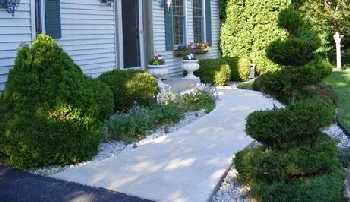
Matching the evergreen species and variety to your soil, sun, wind, climate, region and space is extremely important to its health and life span. Most evergreens live a very long time, and you don’t want to lose one because it won’t thrive or grows too large for its space. Planting an evergreen is not terribly hard work, but digging one out certainly is, not to mention losing several years of growth and starting over with a small young replacement.
There are so many evergreens to choose from. Consider the size you need for the space available, then the shape (tall, rounded, conical, columnar, spreading or arching) and the color (blue, green, yellow or burnished gold). Spend some time browsing catalogs and local nurseries, since each region may have different selections available. The old stand-bys may be hardy and reliable, but you just might find something a little more interesting!
The most important thing to look for is the root system, although that is hard to judge when you cannot see the roots inside the container. If the root system is strong and healthy it will support vigorous growth once replanted, and typically a full, green and healthy looking plant has strong roots. Look for well shaped evergreens: if it is supposed to be a broad cone, do not select a narrow column, although a healthy specimen will develop its natural form once planted. Misshapen or damaged plants should be sold as a lesser grade at a reduced price. There is no need to buy a large evergreen, as most will catch up quickly once established. The only reason I can think of for spending more on a slightly larger plant is curb appeal when you are selling your home.
Soil pH
Certain regions have excessively high or low pH levels. Although most evergreen conifers prefer at least a slightly acid pH, certain species and varieties either thrive naturally in your region or have adapted, so ask when you purchase whether your selection tolerates local pH levels. Amending the soil to alter the pH does little good, since in a couple of years the soil reverts to its original state. A fertilizer formulated for evergreens each spring will usually be enough to prevent iron chlorosis, a yellowing of the foliage due to a lack of acid. If your region tends to have a higher (alkaline) pH, several selections tolerate alkaline soil very well, including Arborvitae and Colorado Blue Spruce.
Planting Site Selection
Most evergreens prefer full sun but can often get by with a little shade. In part shade an evergreen will not grow as quickly and vigorously, but in general it should remain healthy and grow at a slow but steady pace. Some species and varieties are much more fussy about sun, so be sure the site you select provides enough.
Good drainage is very important so the roots can take in not only moisture but also oxygen. Clay soil holds plenty of water but does not drain, so there is little oxygen in the air pockets between soil particles. Sandy soil has plenty of oxygen but lets the water drain right through before the roots can take in enough. To test your drainage, dig a hole (which can later be used for your plant) and fill it with water. If the water does not drain into the surrounding soil, your plant roots will drown; if you cannot fill the hole because the water drains immediately, water will not be available to the roots. Either way, dig your hole much wider and mix in plenty of compost, shredded leaves, and/or peat moss to improve drainage and the texture of your soil.
Size Categories of Conifers
Size categories have been created to standardize terminology in the industry. Not all segments of the industry agree on them, but they do clarify what you can expect when an evergreen is labeled miniature, dwarf, intermediate or large. Mature size is at 10 years growth, the nursery industry standard. Dwarf here is a cultivator’s category term; a true dwarf is any evergreen that does not reach the height of its parent at maturity.
Miniature:
- Mature size at 10 years is 6-10”
- Ultimate size is less than 3 feet
- Growth rate is less than one inch per year (the American Conifer Society lists miniatures as 2 to 3 feet at 10 years, growing less than 3” per year)
Dwarf:
- Mature size at 10 years is 2 – 5 feet
- Ultimate size is 10 to 25 feet
- Growth rate is 2-6” per year
Intermediate:
- Mature size at 10 years is 5 to 15 feet
- Ultimate size is 33 to 50 feet
- Growth rate is 6 to 12 inches per year
Large:
- Mature size in 10 years is 10-25 feet
- Ultimate size is over 60 feet
- Growth rate is 12” or more per year
Growth rates are influenced by the planting site, soil conditions, species, available water and fertilization. Nursery tags always list the mature size at 10 years, but almost never tell you how large the evergreen will be in 20 or 30 or more years. Unless you have researched your selection, assume that in 20 years it will be at least double the 10 year size, and remember that large evergreen trees can live for 100 or more years!
Generously fertilizing a dwarf conifer not only defeats the purpose of buying a dwarf, but shortens its lifespan by encouraging unnaturally fast growth, which is true of any over fertilized plant. Generally, life span is relative to growth rate: a slow growing evergreen will live longer.
Be sure to check the plant details and photos for more specific information about each species and variety.