A little creativity and ordinary materials can protect your hardy roses in the worst winter conditions.
Protecting your roses from harsh winter climates does not have to be difficult or complicated. Tender tea roses and grandifloras will probably have to be buried. Mounding soil at the base to protect the roots and bud union from extreme temperature fluctuations will take care of most hardy roses in the north. But is that enough? and what next?
For starters, make sure you understand what you need to do for your specific rose in your specific climate. Selecting Roses, the levels of protection below, and specific rose information in the Rose Index section should arm you with the information you need to decide what steps to take. Then devise a simple method so you don’t skip an elaborate process one year when you run out of time and wind up losing a rose.
What to Protect Roses From
Some rose bushes can be seriously damaged if the ground surrounding the roots freezes. Hardy rose bushes can be damaged or killed if a cycle of freezing and thawing heaves the root ball up from the soil, so the objective is to keep the rose dormant by keeping the root temperature fairly constant - in other words keeping it frozen! Different varieties require different methods of protection in different climate zones.
Until the ground freezes, continue to water your rose bushes with a soaker hose or slow trickle from the garden hose. Prune lightly, removing only the spindly new top growth to prevent snow and ice from breaking them. Thoroughly clean up all leaves and plant debris from the ground to minimize disease, and spray the stems and the ground with fungicide to reduce the chance of fungus being harbored over winter.
Do not put protection in place until just before the ground is expected to freeze hard, and do not remove it until the earliest spring bloomers have bloomed (in many parts of the country those are forsythia shrubs).
How Much Protection?
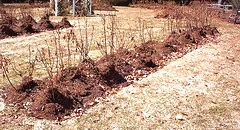
Minimal Protection: Mulch heavily, 3-4 inches deep. For added protection, pile leaves or evergreen boughs in the canes (perhaps in a “tomato cage” to hold them). This will protect the canes from winter wind and bright winter sun, which can scald bare limbs.

Somewhere between minimal and moderate falls a protection that is less used than it used to be, the old white styrofoam rose cones. The canes need to be tied together to fit in the cone, and the cone weighted down so it doesn’t blow away. There is usually a hole in the top for ventilation, but it can still heat up too much inside on sunny winter days; added ventilation holes will eliminate the problem. Cones have largely been replaced by wire rose collars, which are less open than a tomato cage, with more of a wire screen to hold mulch or compost securely. Collars can be used with the minimal or moderate methods.
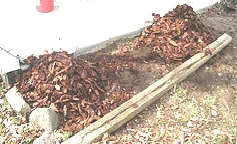
Moderate Protection: Mound soil up around the canes of the rose bush about 6 to 10 inches deep. Add mulch to the top, and leaves or evergreen boughs in the canes as described above. The rose bushes here were pruned down after the first freeze so the entire shrub can be protected by the mulch on top of the mounded soil.
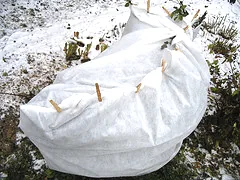
These rose bushes have soil mounded deep at the base to protect the roots, then a porous fabric (row cover fabric or burlap) wrapped around them, filled with leaves and secured at the top. This would be excellent for some of the hardier roses in zones 3 and 4 instead of the Minnesota Tip.
Maximum Protection: The Minnesota Tip method protects rose bushes from extreme cold. It is usually used for hybrid tea roses grown in zones 5 and north, as well as more tender grandifloras. Dig a trench beginning at the base of the bush and extending out slightly further than the height of the plant (the trench should surround the root ball, but not expose the roots). Gently pulling the branches in toward the center, tie the bush up beginning at the base, winding twine around the rose bush to hold the branches together. Tip the tied bush into the trench, leaving the roots in place, cover the entire bush with the soil you removed, then cover with leaves or bags of leaves over the entire area.
Also see winter protection for rose standards and container roses.
A Simple Method for Hardy Roses
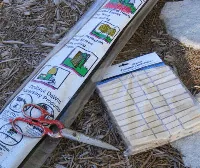
I have made a point to select hardy and easy care roses that require little or no protection in my zone, but no rose is foolproof and winter is unpredictable. So I have a very simple method, using simple materials, to protect my roses. I originally had three Canadian Explorer roses in my garden, now there are two. A particularly harsh winter and no more that a little mulch to protect them killed one of the roses. The Canadian Explorers are very hardy, but do generally die back to the ground each year in zone 4. After losing one I began protecting the roots and bud union with a deep layer of mulch. But as they became better established and larger I decided to keep them large by protecting the whole bush.
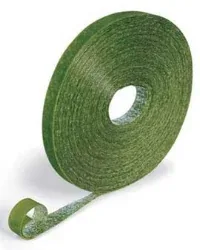
Remember that you are not trying to keep the whole bush warm, but rather protect the canes from sun scald and wind burn, which will quickly kill exposed canes. So when my vegetable garden is done for the season, I place my tomato cages around the rose bushes. If your bushes are wide, you may need to wait until the ground begins to freeze, then pull the canes together and tie them loosely together. Then you will have a more compact bush to protect. Use a soft plant tie, like the self gripping tape you can get from your local nursery, or on line at Gardener’s Supply. Twine can cut into or damage the canes. If you don’t grow tomatoes, you can use chicken wire or garden fencing to enclose the bush. Be sure to stake it to the ground with landscape staples so a stiff winter wind doesn’t pick the whole thing up.
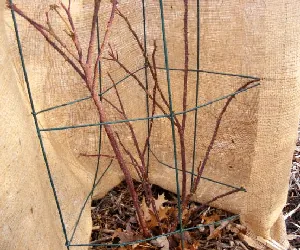
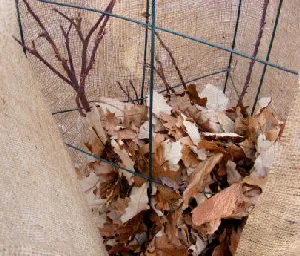
Your tomato cage can be wrapped in burlap, securing the burlap to the cage. Cover and secure the top also to prevent sun scald as the sun gets higher in the sky in late winter. This method also works very well for shrubs that are susceptible to sun scald and wind burn.
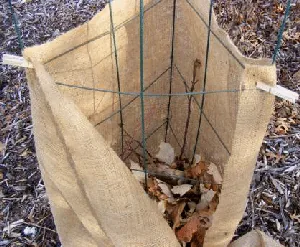
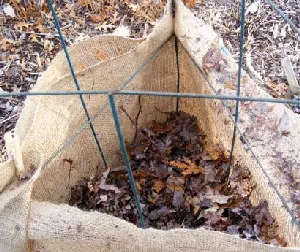
Once I have gone so far as to create a wrapped cage, I take the extra step of filling it with shredded leaves that I save from fall raking. I use my oak leaves which tend to stay drier than most leaves and won’t rot. If your rose is marginally hardy, this offers added protection to your rose. If you have used chicken wire, the cage will hold leaves without being wrapped. You may just fill it up, but once again, a wrapping will offer additional protection for marginally hardy roses. If you fill the cage to the top, completely covering all canes, the burlap covering does not need to be closed
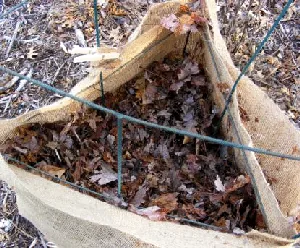
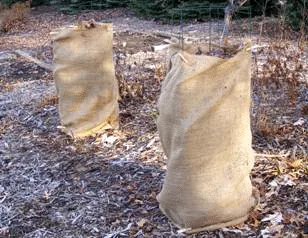
Make it simple, use materials easily available, and the process only takes a few minutes. This protection method is pretty basic and easily used not only for roses, but for marginally hardy shrubs. Protecting evergreens can be done with similar methods, but do have slightly different needs than deciduous shrubs and roses. So check more specific instructions for Protecting Evergreens in Winter.